200 year old guitars
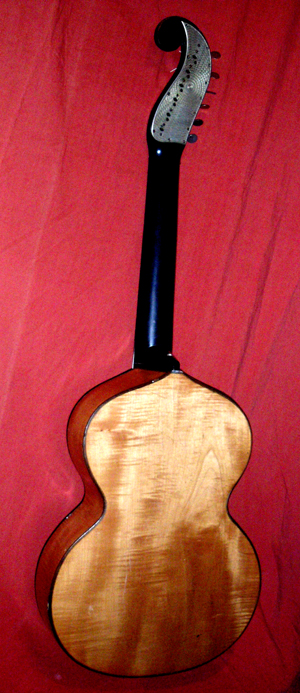
Staufer Guitar
This guitar came in for repair in a very broken condition
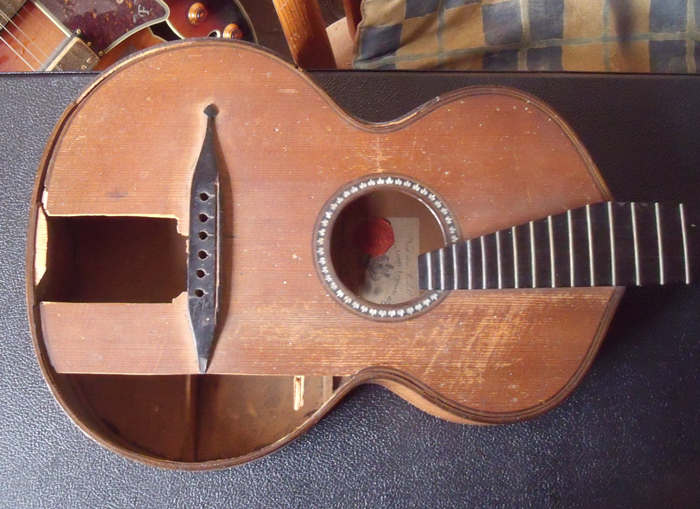
My brief was to make it playable.
Which it now very much is - after a great deal of struggle as over the years the body had distorted and what was left of the top no longer fitted (it had been broken for at least 50 years)
Initially the thought was to replace the top completely but as this was a somewhat historical artefact I decided to save what I could and repair it to the best of my ability.
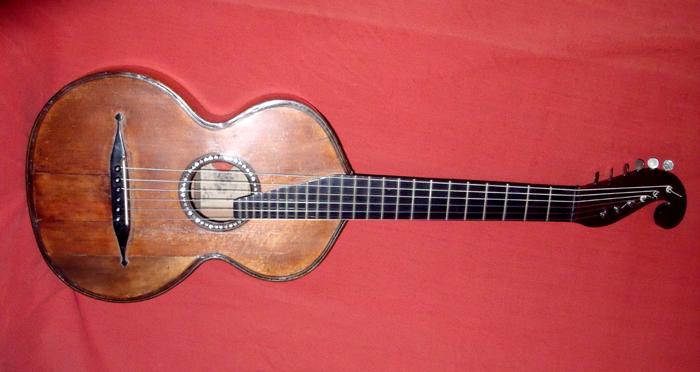
From Wikipedia,
Johann Georg Stauffer (also Johann Georg Staufer; January 26, 1778, in Vienna
– January 24, 1853) was an Austrian luthier[1] and the most important
Viennese luthier of his time.
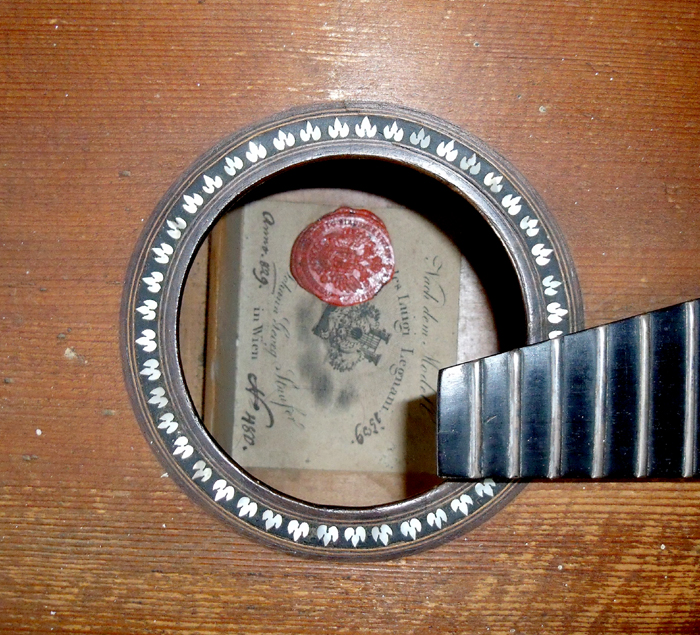
This guitar has a label inside
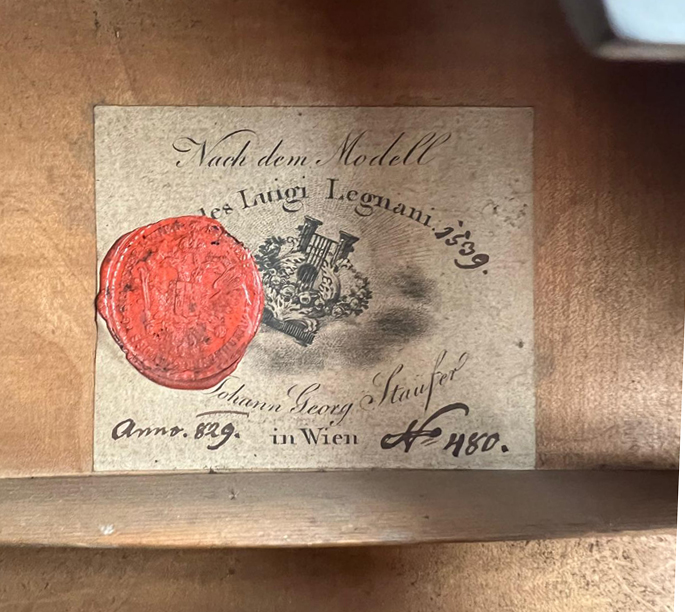
What the label says is that the guitar was made by Johann
Georg Staufer ( note that he spells his own name with one f ) in 1829 in Vienna.
Making it almost 200 years old and certainly the oldest guitar I have ever
worked on.
UPDATE - see the Palormo guitar further down the page which is actually 2 years older
The top of the label says that this model is in the style of Luigi Legnani.
From Wikipedia, Luigi Rinaldo Legnani (7 November 1790 – 5 August 1877)
was an Italian virtuoso guitarist, singer, composer and luthier.[1]
As a regular visitor to Vienna, Legnani cooperated with Johann Georg Stauffer and his son Anton to make guitars according to Legnani's design, to be followed by a number of other luthiers ("Nach dem Modell des Luigi Legnani" / "after the model of Luigi Legnani")
Staufer and CF Martin
Christian Frederick Martin, was born in 1796 in Markneukirchen, Germany, a
centre for instrument making. Martin first studied with his father, Johann
Georg Martin, a cabinet maker. At 15 years of age, he went to Vienna for an
apprenticeship with Stauffer, and in 1825, Martin married Ottilie Kühle, the
daughter of the Viennese harp maker Karl Kühle. Martin remained in Vienna
until at least 1827,[11] after which he returned to his hometown and opened
his own shop. After a long dispute with the guild of luthiers regarding the
rights of cabinet makers to build guitars, Martin emigrated to the United
States of America, where he introduced the mechanism developed by Stauffer
and founded Martin Guitars. In 2008, the 175th anniversary of the Martin Company,
the company released a tribute guitar: the "Martin 00 Stauffer 175th".
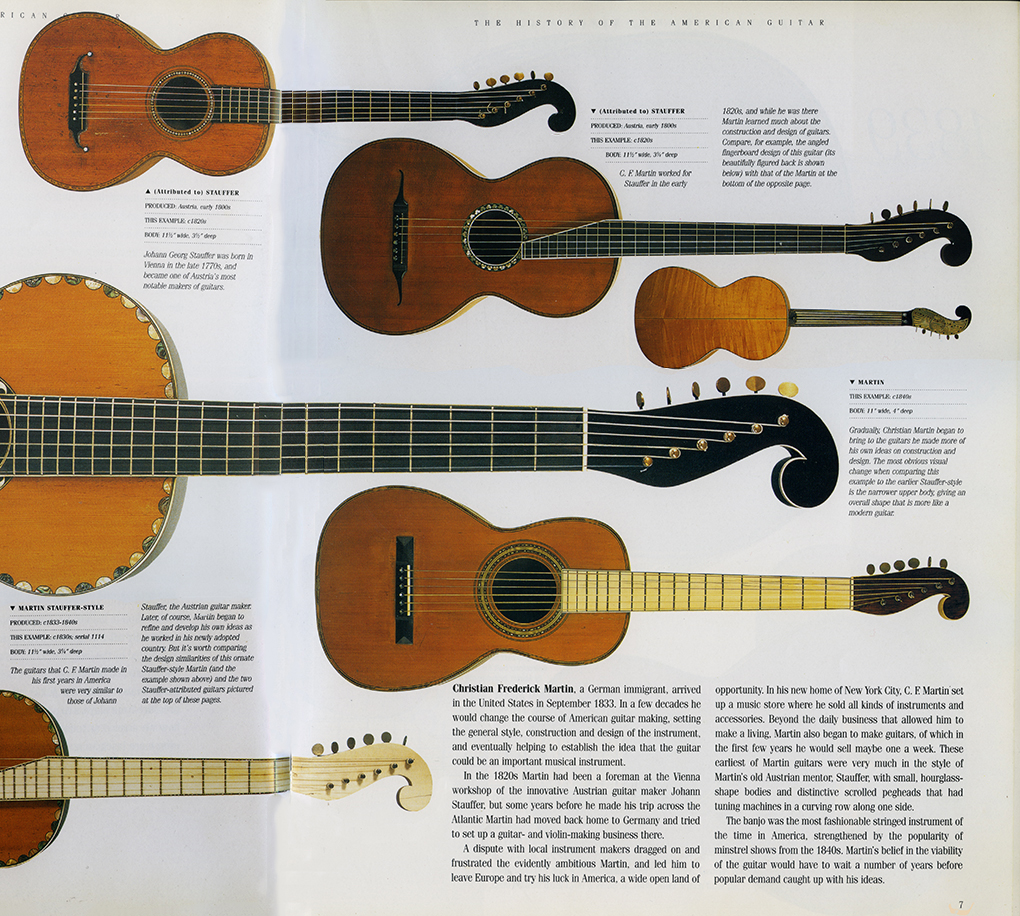
So early Martin guitars were based on this Staufer model.
Some remarkable features
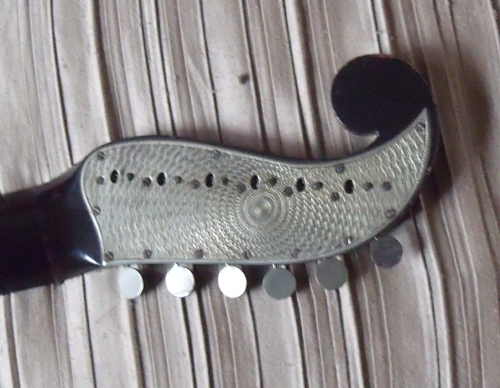
The 6 in line geared tuners are unique in a guitar this old and what's more they still work perfectly.
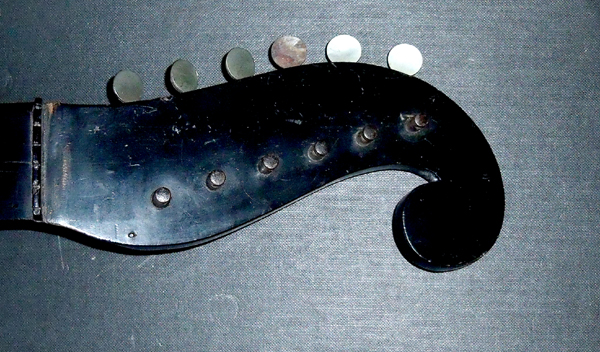
Even more remarkable it has a bolt on neck
This is the external adjuster which is operated by a clock key - not only does it bolt the neck in place but also works to fine tune the neck angle and thus adjust the action.
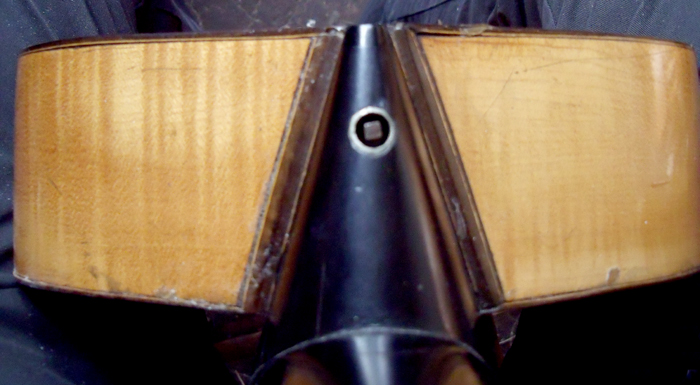
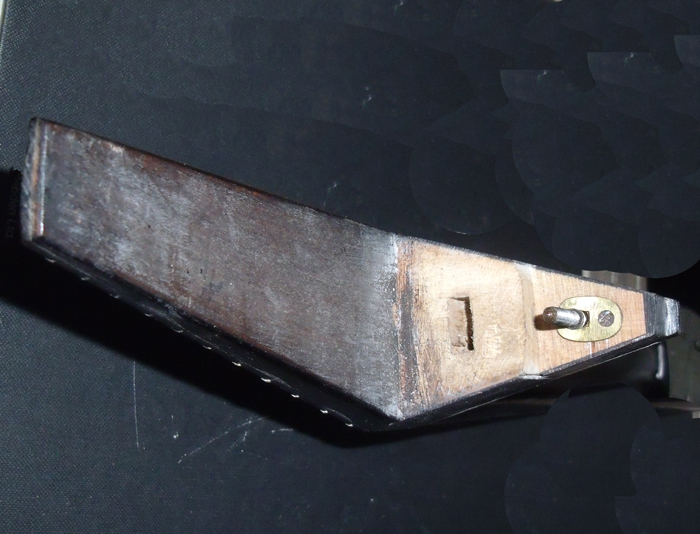
The inside of the neck showing the bolt seated in a metal pocket and the rectangular hole which locates the neck correctly in the pocket.
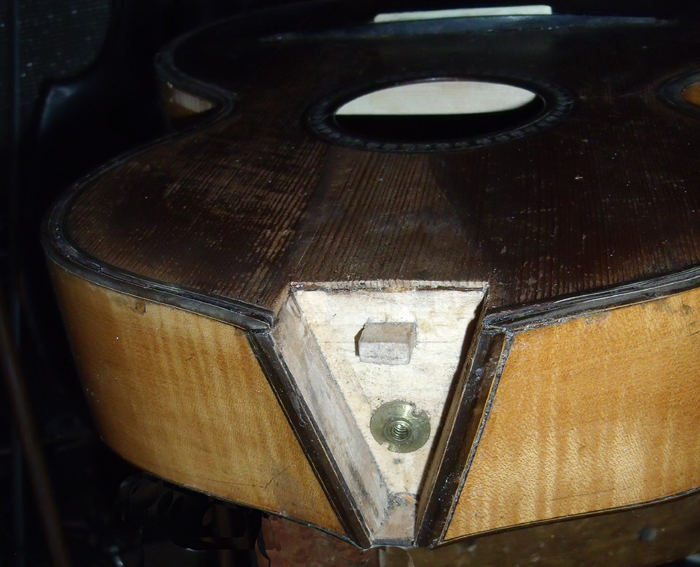
The neck pocket which has a tenon to fit in the rectangular hole and a threaded insert to take the bolt. All very well made and working fine after 200 years.
When I had finally got the Staufer strung up and working I sent a quick video clip to the owner
As you can see in the video this guitar is very small but the sound is much fuller than it should be for such a limited soundbox.
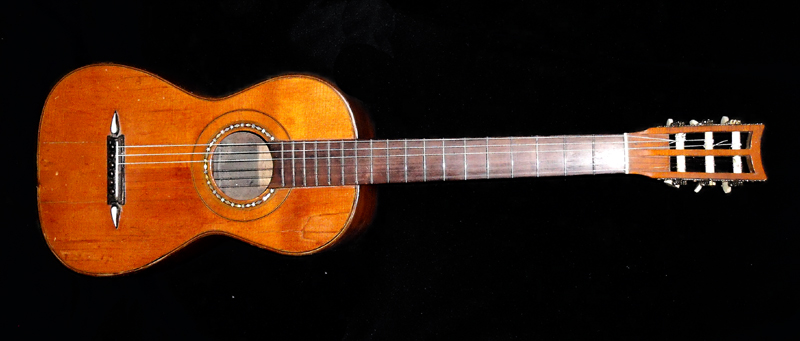
Made by Louis Panormo in London - dated 1827 - it has a label inside
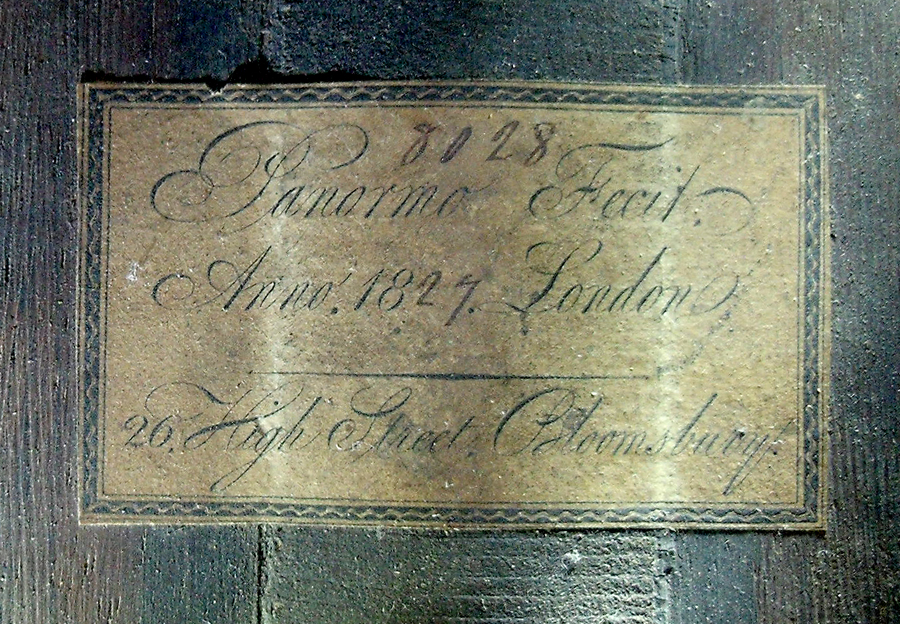
The label says - Panormo Facit (meaning made by Panormo)
Anno (the year) - 1827 - London
and his address - 26, High Street, Bloomsbury
It also features a serial number 8028 - written in, as is the date - I think the label would have been printed from an original , very well executed , piece of copperplate handwriting.
From Wikipedia :
Louis Panormo (1784 – 1862) was a prominent English luthier of the 19th century, best known for his classical guitars,
which were among the earliest made in England to follow the Spanish design.
Often referred to as the "only English guitar maker of the time to make guitars in the Spanish style," Panormo played a significant role in popularizing Spanish-style guitars in Britain during the early Romantic era.
His guitars were played by Fernando Sor and Trinidad Huerta.
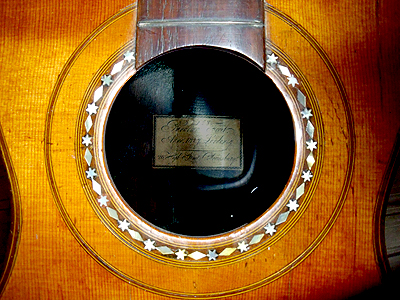
Nice soundhole inlay - mother of pearl stars and diamonds.
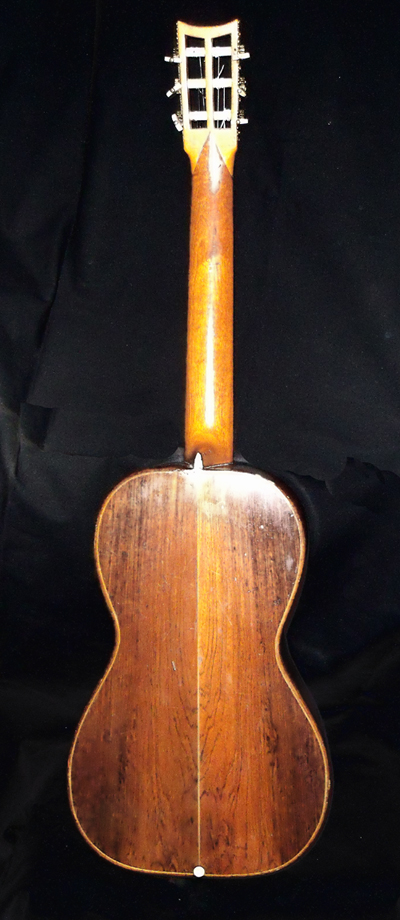
This guitar has a spruce top , rosewood back and sides , a mahogany neck with rosewood fingerboard - the peghead seems to be made of a different wood , possibly sycamore , spliced onto the end of the neck.
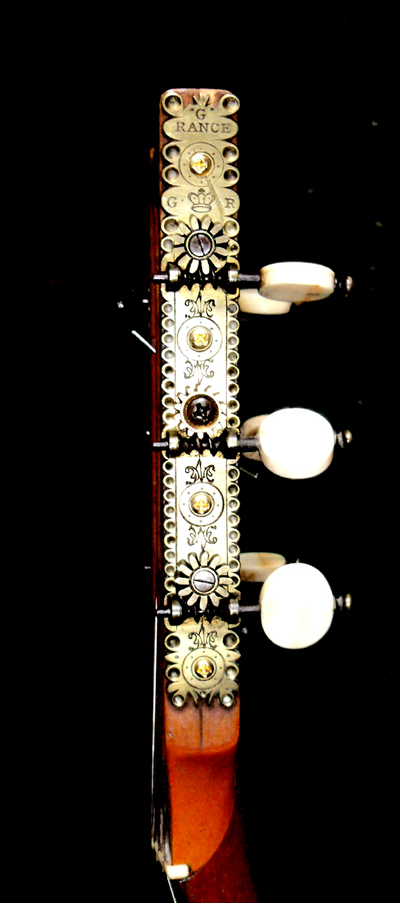
The tuners as far as I can tell are original - made by G Rance which is correct for the date - also on the tuners is a crown engraved with G R which could be for G Rance but more likely stood for King George IV who was the monarch at the time.
The guitar when it came in was generally in quite good condition, considering its age, but was rendered unplayable by a damaged bridge.
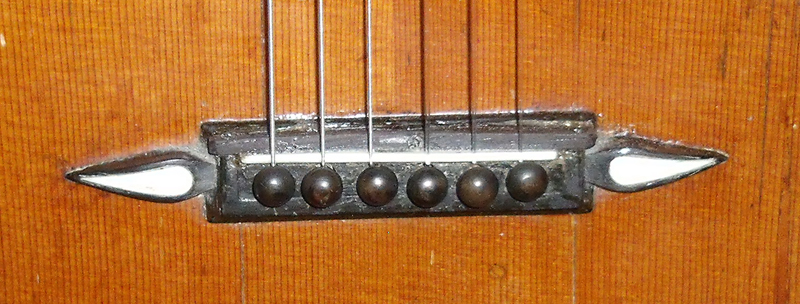
My thoughts on this are that the holes and pegs for the strings are very close to the saddle (no modern guitar would have them that close) - this has the effect of putting a lot of forward pressure on the top of the saddle.
So much so that the saddle had collapsed forwards taking a chunk of the rosewood bridge with it.
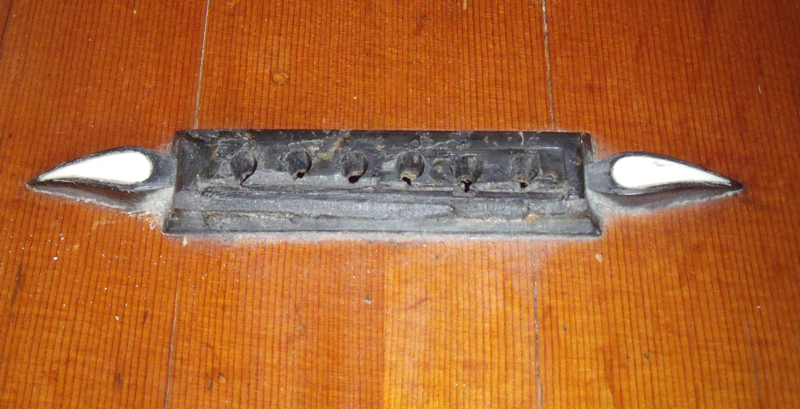
This being an original part of a very old instrument I didn't really want to replace the bridge so I decided to try and fix it.
I started by leveling the broken portion of the bridge and shaping a piece of old rosewood to fill the gap.
I then glued it in place using traditional hot glue - all looked good so I put top and bottom strings on to check the saddle height - tuned them up and all my efforts flew across the room as the string pressure was too much for the glue joint!
Rosewood is an oily wood and as such doesn't glue very well so I determined that the only way to proceed was to reinforce the glue joint with some small screws.
This I managed to do but the screws are thankfully not too visible.
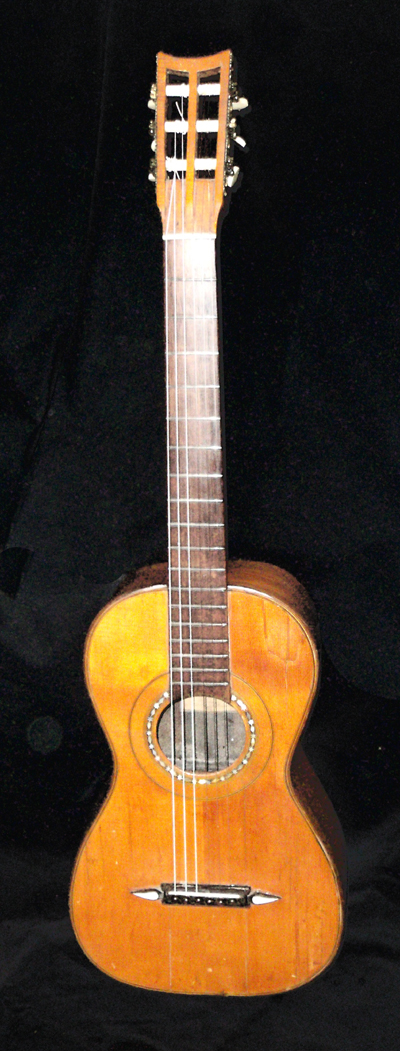
I made a short video of me playing the Panormo - just like the Staufer it is small bodied but has a really good sound.
